What does $338,500 buy in Simsbury that $614,405 doesn't? On paper, both numbers describe the same town, the same school system, the same ten-minute radius off Route 202. In practice, they describe two different housing products that happened to end up inside the same municipal boundary, and the reason traces back further than any zoning map currently on file at Simsbury Town Hall.
If you've already looked at Simsbury's townwide median on a national portal and started touring, you've probably noticed the spread. A condo near the village center lists for $215,000. A ranch-style home on Talcott Mountain Road lists for $650,000. Neither is a fluke. Each is a faithful sample of the neighborhood that produced it, and the neighborhoods were built on completely different assumptions about who would live there and how much land they'd need.
A carpet mill built the floor plan you're touring today
Tariffville exists because of a stone mill. In 1825, the Tariff Manufacturing Company built a carpet and woolen mill near the intersection of what's now Hartford Avenue and Tunxis Road, and the company needed somewhere to put its workers. It built roughly two dozen multi-family houses along Elm Street, Red Hill Road, and Tunxis Place, then added four Greek Revival cottages on Tunxis Road around 1840 for management. Much of that housing is still standing. Part of the original village is now listed in the National Register of Historic Places as the Tariffville Historic District, and it still shapes what a buyer finds on a walk through the neighborhood: duplexes, triple-deckers, and modest single-family homes on small, tightly platted lots, built to house factory workers within walking distance of a job, not to maximize acreage.
One recent sale makes the pattern concrete. A six-bedroom multi-family at 20 Elm Street, built in 1882, closed in October 2025 for $515,000, 14 percent under its original asking price. That's the highest end of what the mill village produces. At the other end, a one-bedroom condo near the historic district recently listed under $100,000, and a two-bedroom unit on Mallard Circle listed at $215,000. As of mid-2026, Tariffville's median sale price sits at $338,500, up 4 percent from a year earlier, on a market that turns over fewer than two dozen homes a year. That's a small, tight market built around small, tight lots, and the price reflects square footage and lot size shaped two centuries ago, not a judgment on the neighborhood today.
What the mountain was built to sell
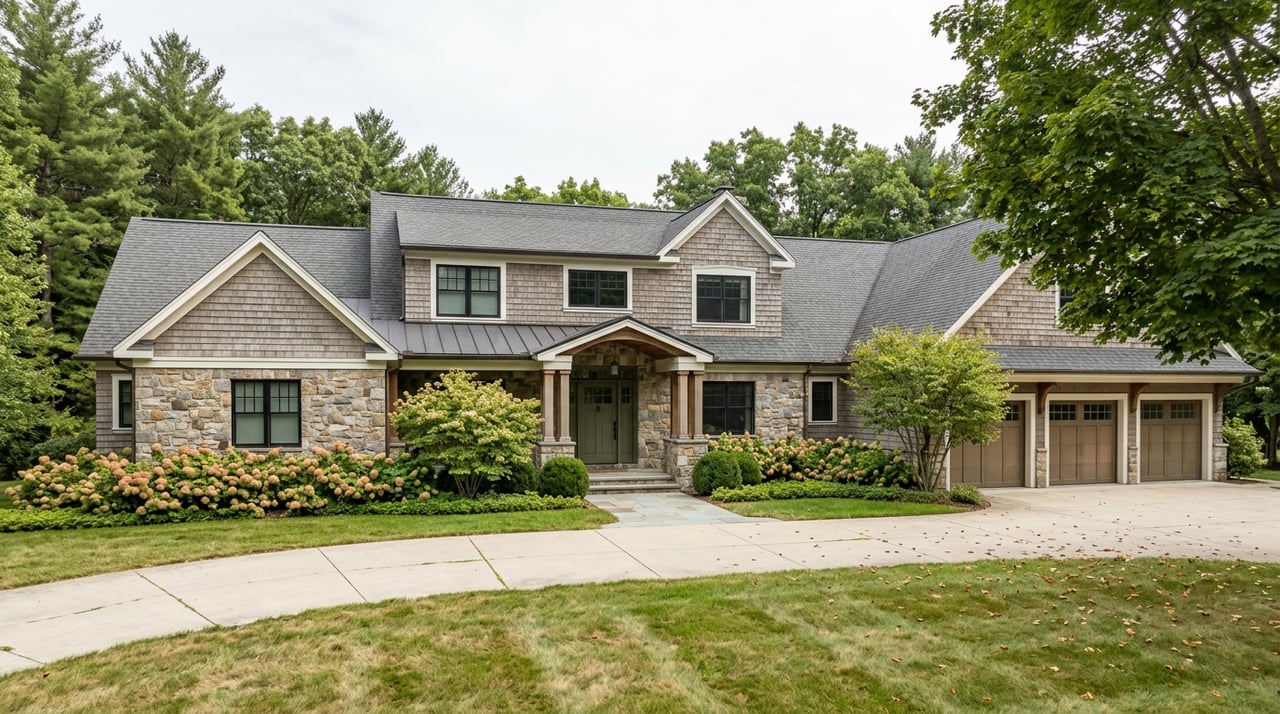
Drive fifteen minutes northwest and the assumptions flip entirely. West Simsbury and East Weatogue sit along the slope of Talcott Mountain, near Penwood State Park, and the housing stock there was platted for a different buyer: one who wanted acreage, privacy, and distance from neighbors, not a walk to a mill gate. Land listings in the area currently include a 6.6-acre estate homesite and a companion 5.79-acre lot sharing the same driveway, both at the base of Avon Mountain. A ranch-style home on Talcott Mountain Road itself, built in 1980 with 3,234 square feet, is currently priced at $650,000, close to $200 per square foot. As of May 2026, Zillow's home value index for West Simsbury put the average home value at $614,405, up 5.1 percent over the prior year. East Weatogue runs even higher: homes there typically sit on at least an acre and range from $700,000 to over $1 million.
The gap between $338,500 and $614,405 isn't a verdict on which neighborhood is "better." It's the difference between a lot platted for a mill worker's rowhouse in 1882 and a multi-acre parcel platted for a custom home a century and a half later. Different products, different eras, same town line.
Same schools, different lot
Here's the detail that should reframe how you're comparing these numbers: this isn't a school-district story. The 1980 ranch on Talcott Mountain Road lists its nearby schools as Tariffville School, Henry James Memorial School, and Simsbury High School. Those are the exact same schools serving Tariffville itself. A family choosing between a $338,500 condo near the historic district and a $650,000 ranch on the mountain isn't choosing between school quality. They're choosing between lot size, housing age, and a completely different daily footprint. That distinction matters, because it means the price premium on the mountain is buying acreage and newer construction, not a better assignment letter.
What you actually inherit at closing
The two housing types come with two different sets of ongoing responsibilities that rarely show up on the closing disclosure until it's too late to negotiate them.
A condo or multi-family in the historic district usually comes with an HOA fee that covers exterior maintenance and shared systems, and sometimes a shared driveway with a neighboring unit. A larger parcel on the mountain comes with the opposite arrangement: you own everything, including the systems most condo buyers never think about. Private wells show up regularly on West Simsbury property records, a line item that simply doesn't exist on a Mallard Circle condo disclosure. Before you compare a $338,500 number to a $650,000 number, it's worth asking your lender or inspector to price out what each structure actually obligates you to maintain, because the mortgage payment is not the full cost of ownership on either end of this town.
What the price is buying, day to day
The daily experience each price point buys is just as different as the deed.
Buy in Tariffville and you're within walking distance of Present Company on Tunxis Road and the Cracker Barrel Pub on Main Street, a neighborhood bar that's been serving the village since 1983. Trilogy gym and the MossLife gift store are close by. The Farmington River runs through the Tariffville Gorge right at the edge of the historic district, a popular spot for whitewater paddlers, and the village hosts the Talcott Mountain Music Festival and the River Run race. There's no grocery store in the village itself. Residents drive about two miles to the Big Y in Simsbury for that.
Buy in West Simsbury and the walk changes entirely. Several current land listings advertise walking distance to Flamig Farm's petting zoo and the Tulmeadow Ice Cream stand, with Simsbury Farms Recreation Complex, its golf course, pools, and ice rink, a short drive away. What you give up in walkable village character, you gain in the kind of land and recreational access that a rowhouse lot from 1882 was never going to provide.
Neither trade is objectively better. It depends entirely on whether your household wants a walk to a pub built into a 19th-century mill village or a private well and six acres at the base of a mountain.
Frequently asked questions
Is Tariffville's lower price a sign of a weaker market? No. The lower median reflects smaller lots and older, denser housing stock, not softer demand. Tariffville's median sale price was up 4 percent year over year as of mid-2026, and homes there have been selling in an average of 37 days.
Are there single-family homes in Tariffville, or is it mostly multi-family and condos? Both exist side by side. The historic district includes single-family cottages built for mill management alongside the multi-family worker housing, and current listings and recent sales span a $215,000 two-bedroom condo up to a $515,000 six-bedroom multi-family that sold on Elm Street.
If the schools are the same, why would anyone pay the West Simsbury premium? Lot size, privacy, and newer construction, not school assignment. Buyers on the mountain are generally paying for acreage and distance between homes, a different product than the walkable, small-lot village center.
If you're weighing a walk to Present Company against six acres near Penwood State Park, the spreadsheet only tells you the price. Understanding which product each number describes is what actually helps you choose. Diana Brown has spent two decades working these exact trade-offs across Hartford County, and a short market consultation can walk you through what each Simsbury price point is really buying before you write an offer.