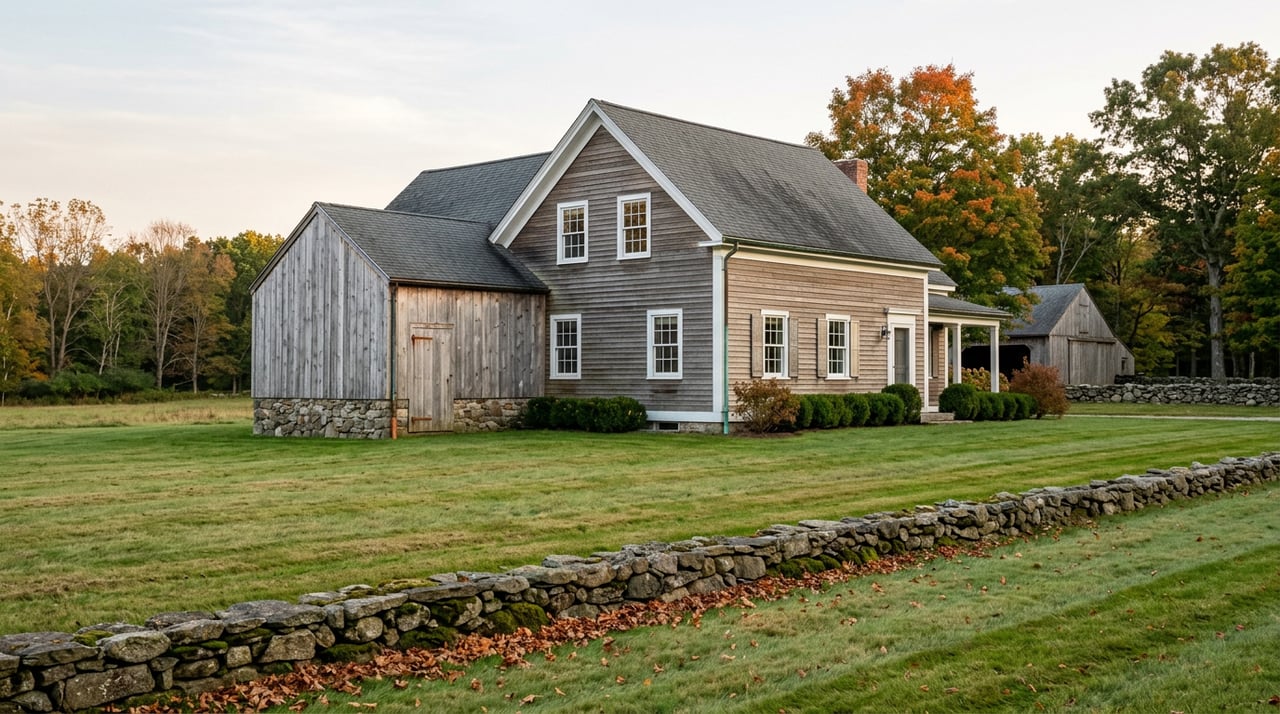
A buyer touring a barn-and-acreage listing on West Road sees the number on the seller's disclosure and does the math in their head: this is what I'll pay in property taxes. It rarely is. Across Ellington, a meaningful share of the town's farm, forest, and open space parcels carry a Connecticut tax classification called Public Act 490, and, as Willington's PA-490 guidance explains, that classification belongs to the person selling the land, not the land itself. It does not survive the closing. The new owner must file a new application by the applicable deadline, and changing the land's use can trigger a penalty.
That's a transaction detail worth understanding before you write an offer on anything in Ellington with more than an acre or two attached.
What that low number actually is
Connecticut's Public Act 490, passed in 1963 and still governing land assessment today under state statutes 12-107a through 12-107f, lets qualifying farm, forest, or open space land get assessed at its use value rather than its fair market value. Use value asks what the land is worth as a hayfield or a woodlot. Fair market value asks what a builder would pay for the same acreage as a subdivision. The gap between those two numbers, on a large parcel, is often the entire reason the tax line on a listing looks so favorable.
The Connecticut Department of Agriculture's own explainer puts it plainly: without the use-value assessment, most owners of farm, forest, and open space land would not be able to afford the property taxes on it and would have to sell. That's the entire point of the law. It keeps land in agricultural or undeveloped use by taxing it as if it will stay that way.
The key qualification is that the assessment assumes the land will remain in that use.
The part of the deal that doesn't come with the deed
Connecticut law specifies how PA-490 classification works. Classification under PA-490 is personal to the owner who applied for it. It does not run with the land. State law is direct: upon sale or transfer of classified property, the classification ceases as of the date of the sale, and a new owner must file a fresh application to keep it going.
Ellington's own assessor's office spells out the mechanics locally. Farmland must actively be farmed, with an application filed with the assessor. Open space needs to be undeveloped land in excess of five acres, and only in zones RA, AA, or A. Forest classification requires at least 25 contiguous acres of qualifying tree growth, verified by a certified forester's report. Three different tests, three different paperwork trails, and none of them transfer automatically.
The application window matters too. In a normal year, Ellington accepts PA-490 applications between September 1 and October 31. In a revaluation year, that window stretches to December 30. Miss it, and the assessor has no choice but to bill the property at full fair market value until the next window opens. If you close on an Ellington farm parcel this fall and want to carry the classification forward under your own name, the paperwork has a hard deadline, and it's this year's, not the seller's.
How a change in use can affect taxes
Buyers should also understand the conveyance tax penalty that can apply to PA-490 land. If classified land is sold, transferred, or changes use, the law imposes a declining tax on the transaction: 10% of fair market value in year one, 9% in year two, stepping down a point a year until it reaches zero at year ten.
Here's the detail that matters for a buyer specifically. For farm and forest land, that ten-year clock starts from the new owner's date of ownership, not from whenever the classification was first granted decades ago. So if you buy a working farm and decide in year four to put in a driveway and build a second house, you're not walking into a clean slate. You're walking into a fresh ten-year window that started the day you took title, and a change of use in year four triggers the applicable conveyance tax based on the land's full fair market value, not its discounted use value. For open space land, the clock instead runs from the year of enrollment, which can make the timing even less intuitive if you're buying land that was only recently classified.
These rules are set out in the statute and are worth reviewing during the search.
Who's actually farming out there
This isn't an abstract legal quirk in Ellington. It's tied to real, working operations that give the classification its teeth. Halfinger Farms on Candlewood Hill Road has been growing pick-your-own daffodils and greenhouse plants since 1996, and turns into a mum and pumpkin destination every September and October. Johnny Appleseed Farm has run pick-your-own apples and peaches on West Road since 1989, with a corn maze and cider donuts each fall. J.T. Farms, also on West Road, raises grass- and grain-fed cattle and sells beef by the cut. Back To The Roots LLC, farming on Windsorville Road and West Road since 1902 under the Rothe family, grows broadleaf tobacco for cigar wrappers alongside a CSA and its own mum patch.
These are examples of working agricultural operations in Ellington. They're also a reminder that PA-490 acreage in Ellington tends to sit next to, or wrap around, land that's genuinely being worked. A buyer looking at a parcel with a barn and a low tax line should ask what's actually growing on it and whether that use is something they intend to continue. If the answer is no, the tax line on the listing is a temporary number, not a permanent feature of the property.
Why this year's number looks different than last year's
Ellington completed a townwide revaluation effective October 1, 2025, and it landed hard. The town's assessor confirms the revaluation raised the grand list by 46.86%. In response, the mill rate dropped from 37.10 the year before to 25.42 for the 2025 Grand List, which starts showing up on tax bills in July 2026.
Do the arithmetic on that and the picture gets more interesting. A revenue-neutral mill rate after a 46.86% grand list increase would land close to 25.26. The town adopted 25.42, which means the average homeowner's real tax burden ticked up slightly even though the headline mill rate fell by nearly a third. A buyer comparing this year's Ellington tax bill against a listing's older tax history is comparing two different assessment worlds. Ellington's next scheduled revaluation isn't until 2030, so the current numbers should hold their shape for a few years, but any prior-year figure attached to a listing needs to be checked against the 2025 Grand List before it goes into a budget.
Questions worth asking before you offer
Is the low tax bill on this listing something I'll actually pay? Only if you apply for and receive your own PA-490 classification after closing, and only if you keep the land in a qualifying farm, forest, or open space use. The seller's classification ends the day the deed transfers.
What happens if I buy the land intending to farm it, then change my mind in a few years? If that change happens within your first ten years of ownership for farm or forest land, expect a conveyance tax based on the property's full fair market value, on a schedule that starts at 10% and steps down one point per year.
Does the acreage matter for which classification applies? It does. Open space requires more than five acres in specific zones, forest requires at least 25 contiguous acres of qualifying tree growth, and farmland has no state-mandated minimum acreage, though the assessor still has to confirm active use.
What this means for your search
None of this is a reason to avoid Ellington's farm and forest properties. Many buyers specifically want that acreage, that privacy, and that working-land character, and the tax mechanics are manageable once you know the calendar and the paperwork involved. What it does mean is that the tax figure on a listing sheet is the seller's history, not a guarantee for you. Before you get attached to a number, it's worth confirming what classification the parcel currently holds, whether it would survive under your intended use, and when the next application window closes.
If you're weighing a farm parcel, a wooded lot, or anything with acreage attached in Ellington, Diana Brown can walk through what a specific property's classification history means for your closing budget and your first ten years of ownership. Schedule a market consultation before you write an offer, not after.
This article is general information, not legal, tax or financial advice. Consult a qualified professional about your situation.